

Prove It! Utility Asset Management: Decision and Dialogue – Let’s continue with our simple business case from last week. Remember? Transformer XYZ is old and gassing: should we replace it this year? We understand intuitively that this question is to do with risk. Is the risk high enough that replacement makes sense?
The classic definition of risk fits perfectly: 𝘳𝘪𝘴𝘬 = 𝘱𝘳𝘰𝘣𝘢𝘣𝘪𝘭𝘪𝘵𝘺 𝘹 𝘤𝘰𝘯𝘴𝘦𝘲𝘶𝘦𝘯𝘤𝘦. Probability and consequence of what? In this case, the implied answer is failure of the transformer. That makes sense—we are thinking about replacing it to avoid a costly failure down the road.
Operations has given us some information about probability—the transformer is old and has high dissolved gases. What about consequences? We need more information!
Perhaps we turn to our SME and ask, “What happens if this transformer fails?”
“Well,” he says, “there are 2,000 residential customers and 2 megawatts of commercial load fed from it. They’d all lose power.”
“For how long?”
“There is another transformer in the station. If all goes well, it would take us about two hours to get down there, have a look around, and close the tie switch to pick up the lost load.”
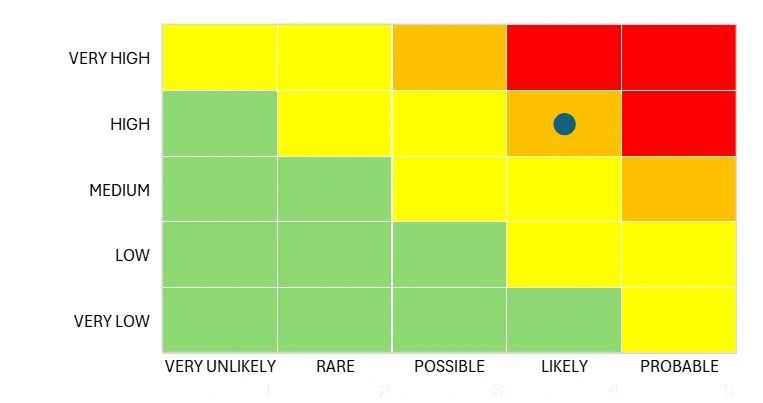
Now we have both blades of our risk scissors in hand. The age and gassing tell us failure is likely, and the large lost load tells us the consequence is high—from our customers’ perspective: no lights (or internet!) for homes, no sales for businesses. We can plot this transformer’s risk in a risk matrix like the one below.
How do we know that failure is likely and not merely possible? Or that consequence should not be medium? Furthermore, this risk is in the orange range, which means it is a high priority and replacement is advised. How do we decide?
Judgment. Maybe yours, maybe the consensus of experts at your company.
Believe it or not, most decisions of whether to replace aging assets are made this way—based on the judgment of experts. Ask yourself: what’s the basis for deciding when to replace a wood crossarm? Or a noisy pump impeller? Is it any more sophisticated than this? Probably not. Even if “high” consequence and “likely” failure have written definitions intended to ensure consistent scoring, they are still just judgment.
Relying on judgment is common but it’s not transparent and it doesn’t support answering the next bunch of questions you’re likely to ask yourself: How do I compare this project with others I might pursue? How do I know orange-colored risk is enough to justify replacement in the first place—why not yellow?
We haven’t been very transparent so far. Next week’s continual improvement will move us beyond expert judgment to estimating the probability and cost of failure using data.
While we wait, are there any risk matrix examples you can share?
#UtilityAssetManagement #ProveItAM #RiskManagement #Risk #BenefitCost #BISConsultingLLC #AssetManagement #ElectricUtilities #WaterUtilities