

Health Indexing: Probably Better Than Nothing – Welcome back! Today’s topic for Prove It! Utility Asset Management is asset health indexing. I admit, I’m not the biggest fan, though it’s the industry’s go-to for condition assessment. Health rolls up inspection results to a single number, but it is subjective, over-interpreted, and rarely predicts failure as well as we imagine. Should we ditch it? Maybe. Here are tips to keep your health indexing tethered to reality.
𝑇𝑖𝑝 1: 𝑅𝑒𝑚𝑒𝑚𝑏𝑒𝑟 𝐶𝑜𝑛𝑡𝑒𝑥𝑡
Why are we interested in health? Because it predicts failure, which is risk, which is an input to our business case. The business case is the point—condition alone can never drive decisions.
Beware health index standards that have conclusions: “HI<30 = replace immediately.” Health without consequence is meaningless: a failing transformer in a low-impact area is not a priority.
You should keep the business case in mind from the start, when you’re deciding on test weightings. If your health index is for end-of-life decisions, emphasize DGA and insulation tests. If it’s for maintenance, focus on repairable indicators like tapchanger performance.
𝑇𝑖𝑝 2: 𝐼𝑚𝑎𝑔𝑖𝑛𝑒 𝑡ℎ𝑒 𝑆𝑡𝑟𝑢𝑐𝑡𝑢𝑟𝑒
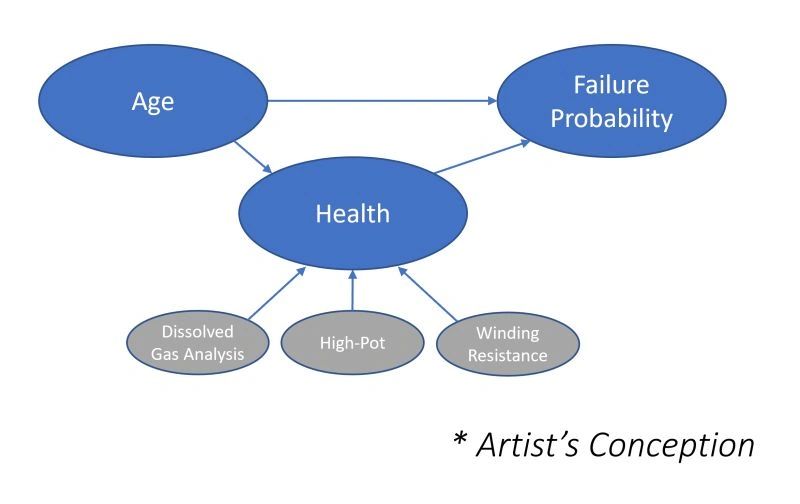
It is helpful to think of degradation this way. As an asset ages, it is more likely to fail, and one way aging works is via condition. Aging drives both health and failure. The figure shows what I imagine it looks like.
Why does the structure matter?
1. A business case needs a time step. Using age puts us into the time domain. Start with the calendar age, then ask, “Given what I know about condition, how old does it 𝑙𝑜𝑜𝑘?” Effective age. The 9% failure probability our SME gave us a few weeks ago came from an effective age of 80 years.
2. Age is known. Starting with age means we can estimate failure probability for any asset.
3. Starting with age helps avoid the temptation to project health into the future, a step not supported by age-health correlations.
4. For many assets, health index does not predict failure well. Our transformer example gives a too-optimistic picture: there are good tests for transformers, highly predictive of failure. But once we turn to, say, breakers, we find that health is less effective.
5. The structure clarifies which inspections to include. Yes, SF6 purity might be important, but is it helpful in predicting failure? If your answer is anything other than yes, leave it out.
6. A path forward. Someday utilities will combine data and 𝑐𝑎𝑙𝑐𝑢𝑙𝑎𝑡𝑒
the relationship between age, condition, and failure. No index needed. For now, health indexing is part of the ecosystem, we can’t avoid it.
I hope that these comments will firm up your approach to health indexing. Next week we’ll talk about consequence costs. Until then, which industry groups could champion better condition data use? Share your ideas! It will take effort, but the rewards are there.