

The Species of Risk – Welcome back to Prove It! Utility Asset Management: Decision and Dialogue. Our topic today is risk.
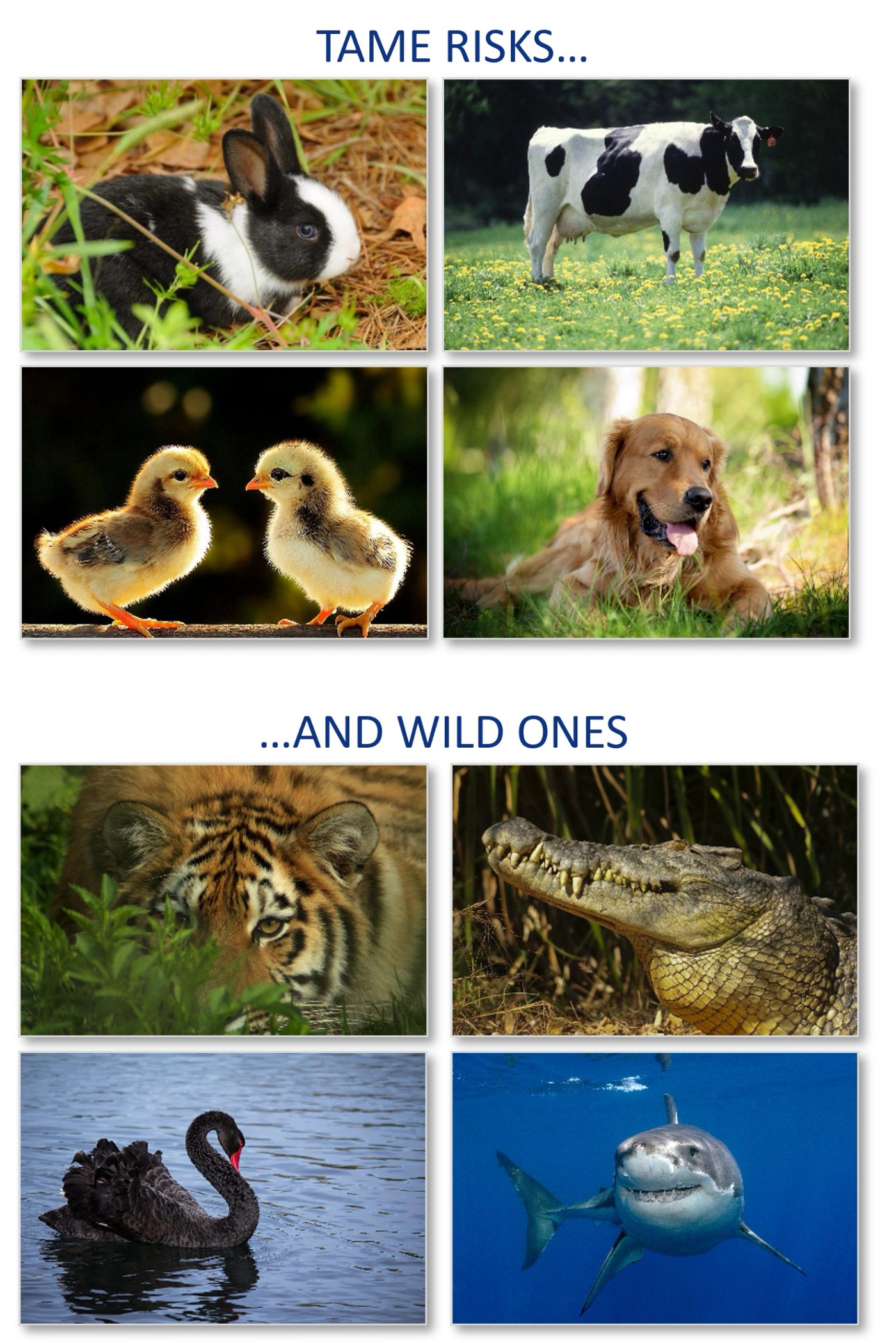
It’s a broad topic, but I want to focus on a single point: there is more than one species of risk—a relatively tame species that we can tackle with our asset management tools, and a wild and dangerous species that requires different tools.
Tame risk is the risk we’ve been talking about so far: probability times consequence, asset management-style risk. It is useful in business cases, where avoided risk is a benefit.
The riskiness of a risk depends on your perspective. If I am served by a particular aging underground cable, whether that cable fails or not makes a big difference to me. But from the perspective of the utility as a whole, this cable is one of thousands, some number of which will fail, and whether this one fails or not doesn’t make much difference. It’s not risky.
Asset managers care about tame risks because performing business cases is our job. But putting dots on a risk matrix and deciding which ones exceed our appetite is not risk management. It’s not even asset management, as we have discussed.
What 𝑖𝑠 risk management, then?
Risk management is how you handle the second species of risk—the wild, dangerous kind. These risks are often small probabilities of extreme consequences, sometimes referred to as the “zero-infinity” problem. How do you plug a zero percent chance of infinite consequences into a business case?
I first encountered wild risk working with West coast utilities on wildfire mitigation. We found we ran out of work that could be justified in normal cost/benefit terms long before the cumulative risk reached a reasonable level. What now?
It’s difficult to justify more and more mitigation with negative net benefits. But exposure to periodic catastrophe doesn’t sound good, either. This is where risk management comes in. You buy homeowner’s insurance in case of fire even though you know that the cost of your premiums exceeds the risk. But you don’t buy the warranty for small appliances. What’s the difference?
The difference is that a house fire is a devastating event, a financial catastrophe from which you may struggle to recover. Failure of a toaster is not like that. For tame risks we minimize expected cost: probability times consequence. But for wild ones we may spend more than the expected cost to avoid disaster.
It is the same for utilities. A large wildfire or a period of runaway energy prices could be an existential crisis. We manage these risks via insurance, hedging, or other means, which are outside the tools normally used by utility asset managers. Our job is to inform the risk managers.
Next time we get together it will be to discuss working with subject-matter experts. Until then I’d love to see some lively conversation in the comments. Am I all wet?
hashtag#UtilityAssetManagement hashtag#ProveItAM hashtag#RiskManagement hashtag#Risk hashtag#BenefitCost hashtag#BISConsultingLLC hashtag#AssetManagement